#Cyber Security
What Is Continuous Assurance in Cybersecurity?
Organizations invest heavily in security tools, compliance programs, and risk management processes. Yet many security leaders still struggle...
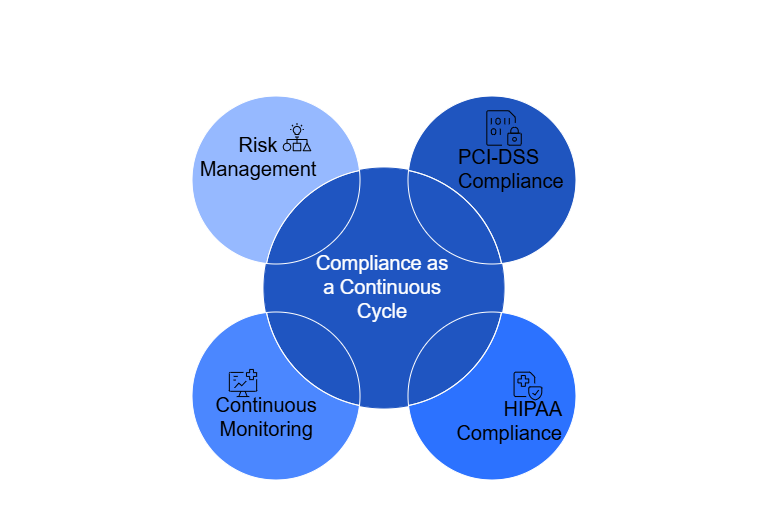
Compliance isn’t just about meeting regulatory requirements; it’s about safeguarding your organization from risks that can cost millions. Yet, many companies still approach compliance as a one-time project, leaving them vulnerable to breaches and fines. In this article, we break down how to transform compliance from a daunting checklist into a dynamic, continuous cycle.
According to a 2024 report by Verizon, 83% of data breaches involve sensitive data like payment information or personal health records. Despite the staggering numbers, many organizations still treat compliance as a one-time project rather than a continuous process. Imagine if you only changed your car’s oil once and expected it to run smoothly forever. Just like your vehicle, compliance needs regular maintenance to keep your organization safe and efficient.
Maintaining compliance with standards like PCI-DSS (Payment Card Industry Data Security Standard) and HIPAA (Health Insurance Portability and Accountability Act) is more than just checking a box. It’s an ongoing cycle of assessing, implementing, monitoring, and improving. Treating compliance as a continuous cycle helps protect sensitive data, sustain customer trust, and reduce risks.
In this article, we’ll explore the principles of cyclical compliance management, focusing on PCI-DSS and HIPAA. We’ll also discuss how to perform regular gap assessments and control validations while leveraging cross-framework synergies to streamline your efforts.
Compliance is not a one-time achievement but an ongoing commitment. To effectively manage compliance with frameworks like PCI-DSS and HIPAA, organizations need to adopt a cyclical approach. This method ensures that compliance efforts evolve alongside changes in regulations, technologies, and organizational practices.
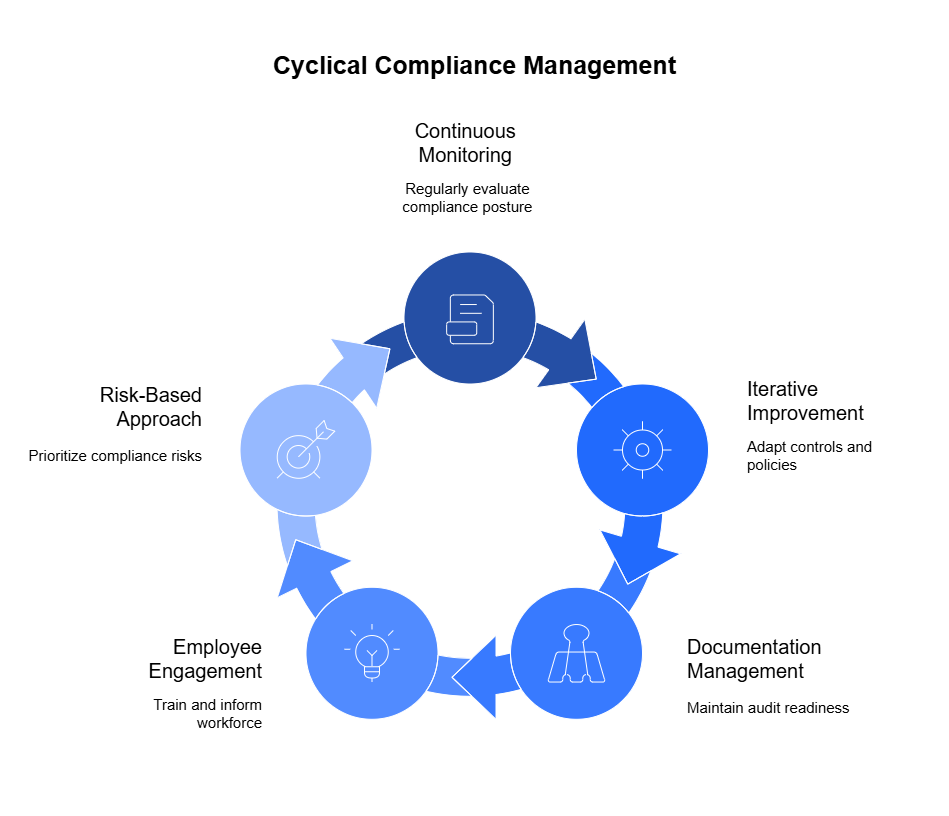
Here are the core principles that form the foundation of cyclical compliance management:
You can’t just set up compliance controls and forget about them. You need to regularly check your organization’s compliance status through automated monitoring. Automated tools can track system configurations, network activity, and data access in real time. They alert you when something goes wrong, like unauthorized access or a security breach.
The goal of continuous monitoring is to detect compliance failures early, before they escalate into significant security incidents or regulatory breaches. By keeping a pulse on your compliance status, you can implement timely corrective actions and maintain a robust security posture. Regular monitoring helps you catch problems before they turn into costly breaches or violations.
Compliance isn’t static. As regulations change or new threats emerge, your policies and controls need to adapt. You can’t just set it and forget it. Instead, take an iterative approach.
Start by reviewing the results from your monitoring. Identify where your controls are weak or outdated. For example, if PCI-DSS updates its encryption standards, make sure your data encryption methods meet the new requirements. Involve your IT, legal, and risk management teams to evaluate the changes. Then, make improvements in a prioritized way, focusing on the biggest risks first. Document what you changed and why, so you have a clear record for future audits.
Accurate documentation is essential for proving compliance. You need to keep detailed records of your policies, procedures, and any changes you make. Also, gather evidence like system logs, training records, and reports from automated monitoring tools.
Use a centralized, automated repository to gather and organize evidence. Automation ensures that documents, logs, and reports are collected and updated consistently without manual intervention. This method makes it easy to retrieve data during an audit or when reviewing compliance status. Clearly label each record with version numbers and update dates to maintain accuracy and clarity. Regularly update your documentation as your processes change. Keeping accurate and current records helps you demonstrate your compliance at any time.
Your employees play a big role in maintaining compliance. They’re often the first line of defense when handling sensitive data. Make sure they know their responsibilities through regular training. Teach them how to handle personal information securely, whether it’s payment data (PCI-DSS) or health records (HIPAA).
Don’t just train them once. Keep compliance awareness fresh with ongoing sessions, quizzes, and real-life scenarios. Tailor the training to fit different roles, since not everyone handles data the same way. Create a culture where employees understand that compliance isn’t just a rule—they’re a key part of keeping data safe.
Not every compliance issue carries the same risk. You need to focus your efforts on the areas that pose the biggest threat. Start by identifying your most critical data—like payment information for PCI-DSS or health records for HIPAA. Determine what would happen if this data got compromised.
Once you know your biggest risks, put stronger controls in place to protect them. For example, use multi-factor authentication for accessing sensitive data and encrypt it both in transit and at rest. Reassess these risks regularly, especially if your organization adopts new technologies or services. Prioritizing your efforts helps you protect what matters most without spreading resources too thin.
When managing compliance, it’s essential to understand the unique requirements of different frameworks. PCI-DSS and HIPAA are two of the most critical standards, especially for organizations handling payment information and protected health information (PHI). Let’s break down the specific considerations for each:
PCI-DSS is crucial for businesses that handle card payments. Its primary goal is to protect cardholder data from breaches and fraud. Here are some key considerations:
1. Data Encryption:
You must encrypt cardholder data both in transit and at rest. Use strong encryption protocols like TLS (Transport Layer Security) to protect data when it’s being transmitted. For data at rest, consider using AES-256 encryption. Always store encryption keys securely and limit access to authorized personnel only.
2. Secure Network Architecture:
Build and maintain a secure network by implementing firewalls and intrusion detection systems (IDS). Segment networks to isolate cardholder data environments (CDE) from other networks. Regularly test your network to identify vulnerabilities and apply patches as soon as they become available.
3. Access Control Measures:
Restrict access to cardholder data on a need-to-know basis. Implement multi-factor authentication (MFA) for users accessing the CDE. Monitor and log all access attempts to detect unauthorized activities.
4. Regular Testing and Monitoring:
Continuously monitor your systems for vulnerabilities and perform regular penetration testing. Log and track all access to network resources and cardholder data. Implement automated monitoring tools to detect unusual behavior in real time.
5. Incident Response Plan:
Have a clear plan for responding to data breaches involving cardholder information. This should include immediate containment, forensic investigation, and customer notification. Test your plan regularly to ensure effectiveness.
HIPAA focuses on the security and privacy of protected health information (PHI). Organizations that handle PHI, such as healthcare providers and their business associates, must comply with strict regulations. Here’s what you need to consider:
1. PHI Handling:
Identify and classify PHI within your systems. Ensure that all PHI is encrypted both in transit and at rest. Use strong access controls to limit who can view or handle sensitive health data.
2. Data Integrity and Availability:
Implement measures to protect data from unauthorized alteration or destruction. Use backup solutions to maintain data availability, even in the case of a security incident. Regularly verify the integrity of stored data and ensure it hasn’t been tampered with.
3. Access Controls:
Grant access to PHI only to those who need it to perform their job duties. Use role-based access controls (RBAC) to manage permissions. Require strong authentication, including MFA, to access PHI.
4. Audit Controls:
Implement automated logging to track access to PHI. Regularly review these logs to detect any suspicious activity. Store logs securely and ensure they are tamper-proof.
5. Employee Training on Privacy Rules:
Educate employees on how to handle PHI securely. Include training on identifying phishing attempts and securing devices that access PHI. Regularly update training materials to cover emerging threats and regulatory updates.
6. Breach Notification:
Have a defined process for notifying affected parties in case of a data breach. This includes notifying individuals whose PHI was compromised, as well as relevant regulatory bodies. Document every step taken to respond to the breach.
While PCI-DSS and HIPAA focus on different types of data, they share some common principles:
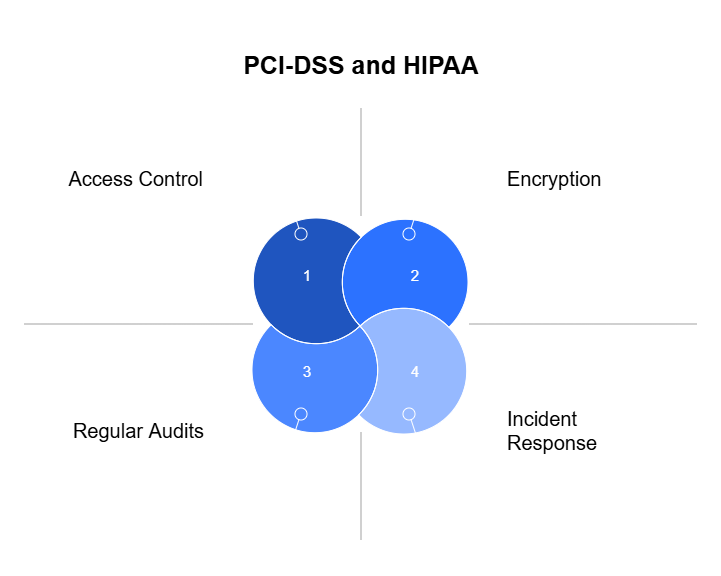
By understanding the unique and shared requirements of PCI-DSS and HIPAA, you can build a more resilient compliance strategy. Integrating these standards helps reduce redundancy and enhances your overall data security posture.
Maintaining compliance is an ongoing process that requires regular assessments and validations. Even if your organization has achieved compliance, risks can evolve due to changing regulations, new technologies, or emerging threats. Regular gap assessments and control validations help you identify areas where your compliance measures might fall short and ensure your controls remain effective.
A gap assessment helps you compare your current compliance status against the requirements of standards like PCI-DSS and HIPAA. The goal is to identify where your practices don’t meet regulatory expectations. Here’s how to conduct an effective gap assessment:
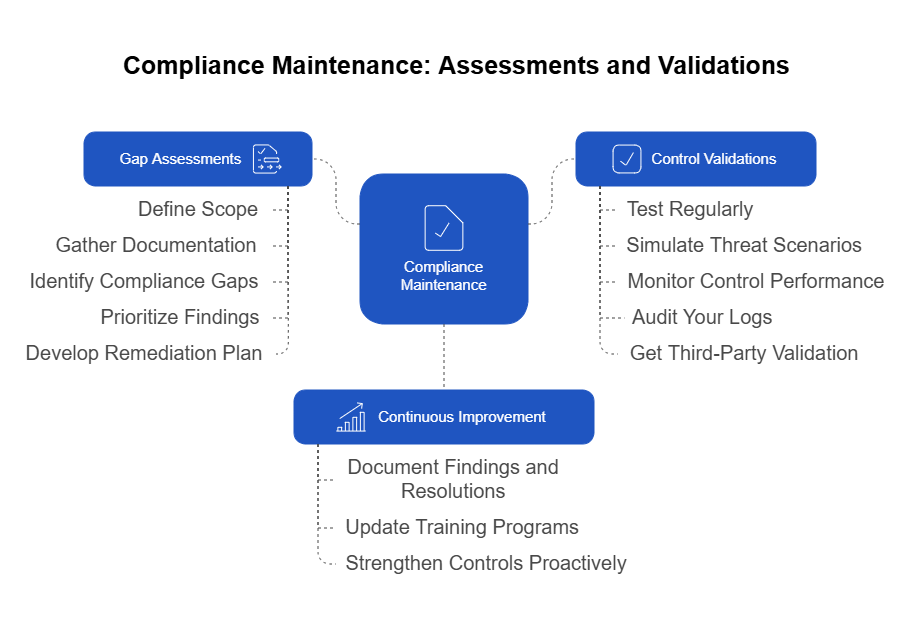
After identifying gaps, it’s crucial to validate the effectiveness of your compliance controls. Controls are the specific practices, systems, and policies you put in place to meet compliance requirements. Here’s how to validate them effectively:
Gap assessments and control validations shouldn’t just be a periodic exercise. Use the insights from these processes to refine your compliance strategy continuously. Develop a feedback loop that captures the lessons learned from each assessment and validation.
Regular gap assessments and control validations are vital in maintaining compliance and safeguarding your organization against data breaches. Neglecting these practices can lead to significant vulnerabilities. For instance, organizations with a high level of noncompliance with regulations experienced an average data breach cost of $5.05 million, which is 12.6% higher than the average breach cost. This underscores the financial risk of inadequate compliance measures.
By conducting regular assessments and validations, you proactively identify and address weaknesses, reducing the likelihood of costly incidents. This proactive approach not only ensures compliance but also strengthens your organization’s overall security posture.
Organizations often face the challenge of complying with multiple standards simultaneously, such as PCI-DSS and HIPAA. Managing each framework independently can lead to redundant efforts, increased costs, and potential inconsistencies. Instead, adopting a unified compliance strategy helps streamline processes and reduces duplication. Here’s how to achieve cross-framework synergy:
Many compliance frameworks share similar requirements, particularly in areas like data encryption, access control, and incident response. Start by mapping these overlapping controls. For instance:
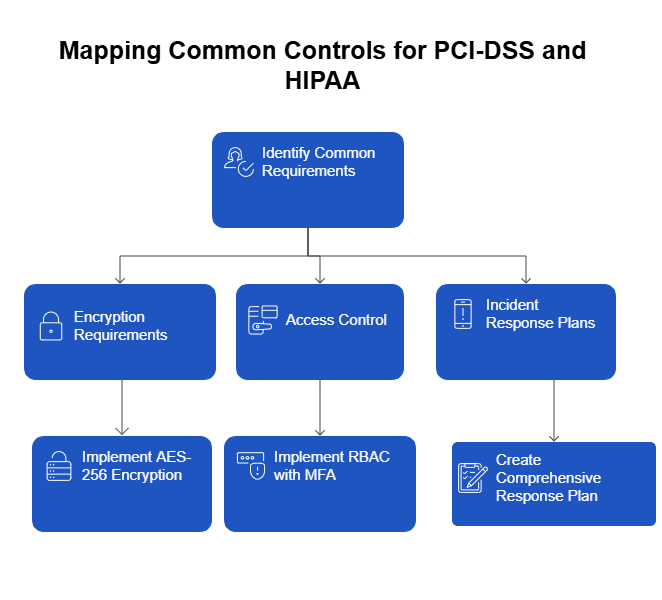
By identifying these commonalities, you can develop a unified control set that covers multiple frameworks, saving time and resources.
Using a centralized platform to manage multiple compliance frameworks makes it easier to track and update controls. Choose continuous compliance automation tools that support multi-framework integration, allowing you to monitor compliance metrics, track policy changes, and manage documentation from a single dashboard.
Compliance should not be siloed within a single department. Form cross-functional teams that include IT, legal, risk management, and data governance experts. This collaborative approach ensures that compliance strategies consider diverse perspectives and expertise.
Instead of addressing each framework individually, prioritize compliance efforts based on risk. Focus on areas where non-compliance would have the most significant impact, such as data breaches involving both payment data and PHI.
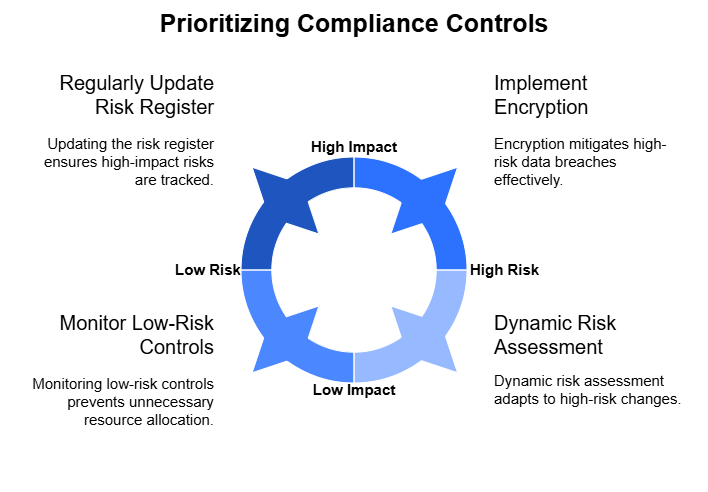
Many organizations struggle with maintaining separate documentation and workflows for each standard. Use bridging tools and templates that align multiple frameworks into a single compliance matrix.
By integrating compliance efforts, you reduce redundancy and save resources. You also minimize the risk of conflicting policies or duplicate audits, which can confuse employees and auditors alike. A streamlined approach to managing multiple frameworks ensures consistency, simplifies reporting, and fosters a more holistic understanding of compliance throughout the organization.
Adopting cross-framework synergy not only makes compliance management more efficient but also helps maintain a stronger security posture by addressing shared vulnerabilities. This proactive approach supports long-term regulatory adherence and reduces the likelihood of compliance failures.
Compliance is not a destination; it’s a continuous journey. Treating compliance as a one-time project can leave your organization vulnerable to evolving risks and regulatory changes. Instead, adopting a cyclical approach ensures that your compliance efforts stay aligned with current standards, protect sensitive data, and support long-term security goals.
By implementing continuous monitoring, iterative improvements, and robust documentation practices, you build a proactive compliance strategy that evolves with your organization. Addressing the unique requirements of PCI-DSS and HIPAA while leveraging cross-framework synergies helps reduce redundancy and streamline your compliance management.
Moreover, fostering a culture of continuous compliance empowers employees to take ownership of data protection practices, making compliance an integral part of daily operations rather than a separate task. Regular gap assessments and control validations keep your program resilient, while real-time monitoring and automated systems enhance your ability to detect and respond to threats.
In the end, the key to successful compliance lies in consistency, collaboration, and a willingness to adapt. By embedding compliance into your organization’s culture and practices, you reduce risks, build customer trust, and stay ahead.
Organizations invest heavily in security tools, compliance programs, and risk management processes. Yet many security leaders still struggle...
Introduction — When the Cloud Shakes, Compliance Crumbles When AWS’s US-east-1 region went dark, so did thousands of...
Introduction There are two sides to a coin and AI is no exception. AI’s versatility is what makes...