#Cyber Security
What Is Continuous Assurance in Cybersecurity?
Organizations invest heavily in security tools, compliance programs, and risk management processes. Yet many security leaders still struggle...
There are two sides to a coin and AI is no exception. AI’s versatility is what makes it useful across a vast array of use cases. And yet, it carries several risks when left unchecked. Recognizing the urgency of addressing these twin forces of promise and peril, the Reserve Bank of India (RBI) constituted the FREE-AI Committee and, in August 2025, released the Framework for Responsible, Ethical, and Effective AI Regulation (FREE-AI).
The Free-AI framework is a much needed respite for the Indian financial sector. This framework could possibly steer the Indian financial sector towards large-scale AI adoption, whilst balancing innovation with systemic stability and ethical governance.
According to the survey conducted by RBI, AI adoption among supervised financial entities remains limited, primarily due to low uptake by smaller institutions such as Urban Co-operative Banks (UCBs) and Non-Banking Financial Companies (NBFCs).
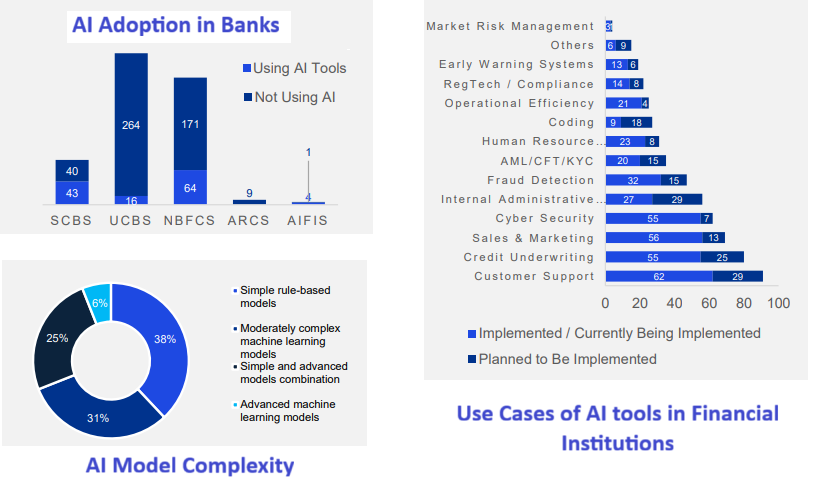
Where AI is being used , the most common use cases are in low-risk, high-volume applications such as customer support, sales and marketing, credit underwriting, and cybersecurity. The survey also indicated that the majority of institutions relied on simple rule based non learning AI models and moderately complex ML models, with limited adoption of advanced AI models.
Financial institutions expressed significant concerns about adopting advanced AI due to risks such as data privacy breaches, cybersecurity vulnerabilities, governance gaps, and reputational damage. Many lacked formal governance structures, with only about one-third having board-level oversight and even fewer maintaining incident response mechanisms. Data management practices were fragmented, with no dedicated policies for AI training datasets and limited use of tools for bias detection or model monitoring.
Despite these challenges, the demand for regulation was overwhelming: 85% of respondents voiced a strong need for a clear regulatory framework to guide responsible AI deployment.
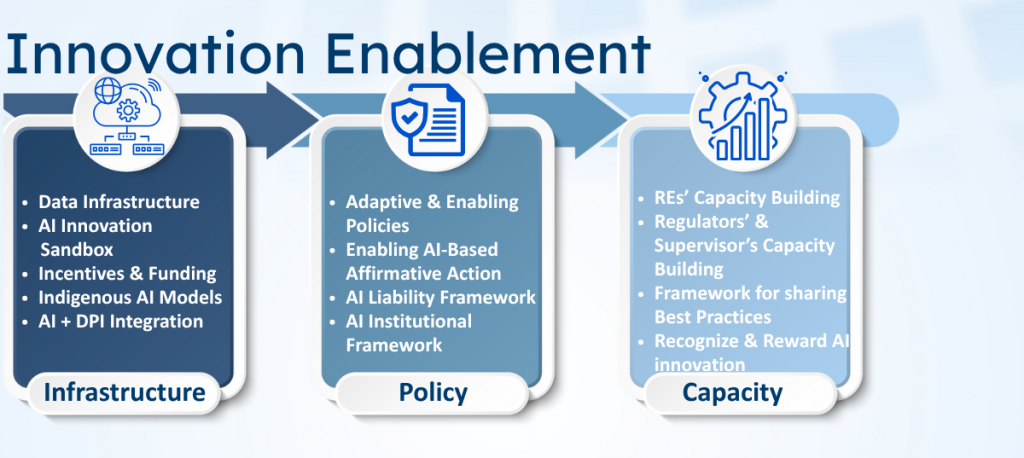
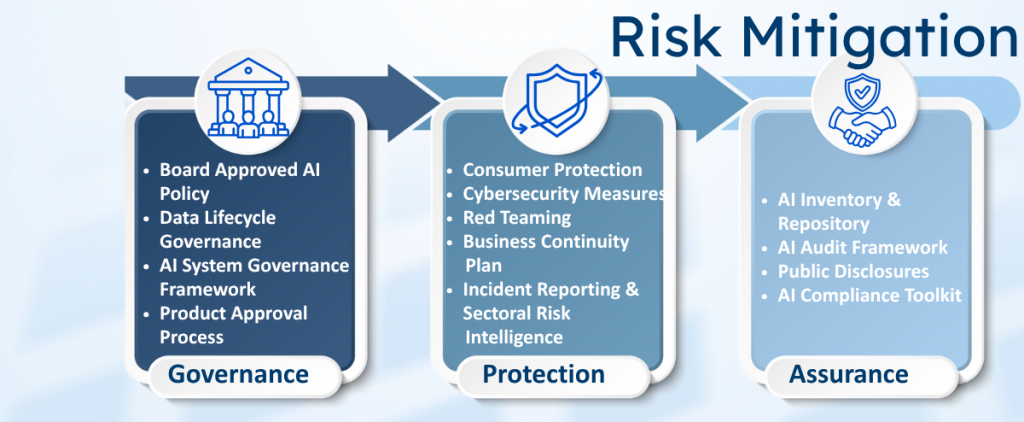
It is this reality that shaped the RBI’s FREE-AI framework—a unifying vision anchored in seven ethical Sutras and a six-pillar architecture that integrates innovation enablement (Infrastructure, Policy, Capacity) with risk mitigation (Governance, Protection, Assurance). Together, they provide the scaffolding for a financial ecosystem where AI augments human intelligence, deepens inclusion, and strengthens institutional integrity.
India stands at the heart of AI transformation. With its vast, multilingual, and digitally connected population, the country presents a unique opportunity to use AI as a lever for financial inclusion. Advances in multilingual and multimodal AI, capable of understanding regional languages and low-literacy inputs, can bridge long-standing gaps in access to banking, credit, and insurance.
The FREE-AI Framework is designed to ensure that India’s financial AI revolution is guided by responsibility, explainability, and resilience. As cited in the report some of the AI Adoption barriers that the framework aims to address include:
When AI models are trained on incomplete or skewed datasets, they can reinforce existing social or financial biases—affecting credit approvals, pricing, or inclusion. FREE-AI promotes fairness-by-design through better data governance, bias detection tools, and regular model audits to ensure outcomes remain equitable and inclusive.
Opaque “black-box” models undermine both regulatory scrutiny and customer trust. The framework embeds Explainable AI (XAI) as a design principle, requiring documentation, transparency tools, and interpretability standards so that every automated decision can be understood and justified.
Errors in AI systems can scale rapidly across high-volume transactions, leading to financial or reputational loss. FREE-AI addresses this through continuous model validation, red-teaming, and human-in-the-loop oversight to prevent unchecked automation and systemic contagion.
Many smaller institutions depend on external vendors or cloud-based AI systems, often without visibility into how these models are trained or governed. The framework strengthens vendor accountability by requiring contractual compliance with ethical and data protection standards, and promotes the creation of a repository of audited AI models.
AI can be both a defensive asset and a vulnerability. FREE-AI calls for AI-specific cybersecurity measures, such as adversarial testing, Business Continuity Plans (BCPs), and privacy-preserving techniques like federated learning to guard against model manipulation and data breaches.
AI-driven financial decisions can directly impact customers’ rights and trust. The framework embeds consumer protection and ethics into its core—mandating transparency in AI usage, clear grievance redressal mechanisms, and the principle of “People First”, ensuring human welfare remains central to all AI applications.
The FREE-AI Framework applies to all entities operating within India’s regulated financial ecosystem that develop, deploy, or depend on Artificial Intelligence systems in the course of their business.
Its scope is intentionally broad—recognizing that AI use in finance extends far beyond core banking—to ensure uniform ethical and governance standards across the entire sector.
FREE-AI directly applies to all RBI-regulated entities, including:
These institutions are expected to implement the framework’s governance, protection, and assurance mechanisms, including AI policies, model inventories, disclosure standards, and internal audit processes.
Given the extensive outsourcing of AI tools and analytics in the sector, FREE-AI also extends to fintech partners, data analytics firms, RegTech providers, cloud platforms, and AI vendors that design or manage models used by regulated entities.
The framework also envisions coordination among India’s financial-sector regulators and supervisory agencies—including RBI, SEBI, IRDAI, and PFRDA—to harmonize AI oversight, share risk intelligence, and establish a National Repository of Audited AI Models.
This multi-agency approach prevents regulatory fragmentation and supports consistent risk management across markets and products.
FREE-AI’s provisions span the entire AI lifecycle, covering:
In other words, it applies not only to the use of AI, but also to how it is built, maintained, and governed—ensuring continuous accountability from conception to retirement.
Recognizing the diversity of entities and use cases, FREE-AI adopts a risk-based, proportionate approach:
This graduated framework ensures that compliance expectations remain practical and scalable, particularly for smaller institutions and early-stage fintechs.
At the heart of the FREE-AI Framework lies a set of seven ethical anchors—known as the Seven Sutras of Responsible AI. These Sutras serve as the moral and operational compass for all stakeholders in India’s financial ecosystem. Inspired by India’s philosophical tradition of balance between progress and prudence, they translate abstract ideals of ethics and fairness into actionable design and governance principles.
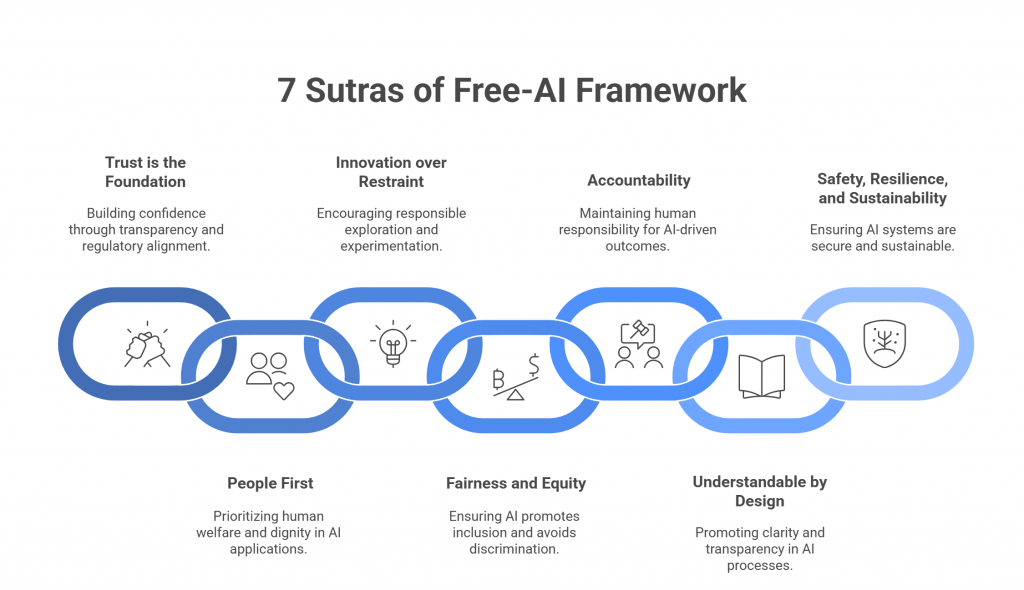
Each Sutra encapsulates a core value that the RBI believes must underpin every AI system used in finance—ensuring that technology serves people, institutions remain accountable, and innovation advances in harmony with public trust.
Trust forms the bedrock of financial systems—and by extension, of AI in finance. Without trust, even the most sophisticated algorithms lose legitimacy. This Sutra calls for AI systems that are transparent, auditable, and aligned with regulatory expectations. Institutions must ensure that every AI model deployed strengthens, not erodes, consumer confidence in the financial system.
In practice: Building trust means clear communication with customers when AI is used in decision-making, providing avenues for explanation and redress, and maintaining transparency in model outcomes and data handling.
AI should always augment human judgment, not replace it. This principle asserts that humans remain accountable for decisions, even when aided by automation. The goal is to design systems that empower employees and protect consumers—keeping human welfare, dignity, and fairness at the center.
In practice: Implement “human-in-the-loop” controls for critical decisions like loan approvals, fraud detection, or risk scoring, ensuring final authority rests with qualified personnel.
This Sutra reflects the RBI’s belief that regulation should enable innovation responsibly, not stifle it. Financial institutions are encouraged to explore AI’s potential in safe, supervised environments such as AI sandboxes—spaces that promote experimentation while embedding ethical oversight and risk controls.
In practice: Use the AI Innovation Sandbox and shared data infrastructure to prototype, validate, and deploy AI solutions safely, ensuring they meet fairness and explainability standards before full rollout.
AI should be a tool for inclusion, not exclusion. Models trained on biased or incomplete data risk perpetuating discrimination. This Sutra mandates fairness-by-design—embedding bias detection, data validation, and equitable access mechanisms throughout the AI lifecycle.
In practice: Conduct fairness testing, document datasets and model logic, and use diverse training data to minimize bias. Prioritize inclusive design that reflects India’s multilingual, socio-economic diversity.
Responsibility for AI decisions cannot be outsourced to algorithms or third-party vendors. This Sutra ensures that humans—and institutions—remain answerable for every AI-driven outcome. Every regulated entity must establish clear governance structures, assign ownership of AI risks, and maintain auditable trails for decisions.
In practice: Appoint a Chief AI Ethics Officer (CAIEO) or equivalent role, and ensure that all AI models undergo internal and third-party reviews for compliance and ethical alignment.
AI must be explainable, interpretable, and transparent. This Sutra mandates that model logic, data sources, and decision outcomes be clearly understood by developers, regulators, and customers alike. The goal is to replace black-box opacity with clarity and confidence.
In practice: Maintain Model Cards, Data Sheets, and explainability dashboards that document model purpose, data lineage, and decision pathways. Use explainable ML techniques where possible.
AI systems should be secure, robust, and designed for long-term sustainability. As models become more autonomous, they must withstand adversarial attacks, data drift, and operational shocks without compromising integrity or consumer protection.
In practice: Incorporate cybersecurity testing, business continuity plans (BCPs), and energy-efficient AI practices. Regularly validate and retrain models to adapt to evolving data and regulatory conditions.
The FREE-AI Framework transforms the RBI’s ethical vision into a practical governance blueprint, bridging the gap between principle and implementation.
While the Seven Sutras define how AI should behave, the framework’s two sub-structures—Innovation Enablement and Risk Mitigation—outline how institutions should act to achieve that ideal.
Together, they form a six-pillar architecture supported by 26 specific recommendations that guide financial entities, regulators, and technology partners in deploying AI safely, responsibly, and effectively.
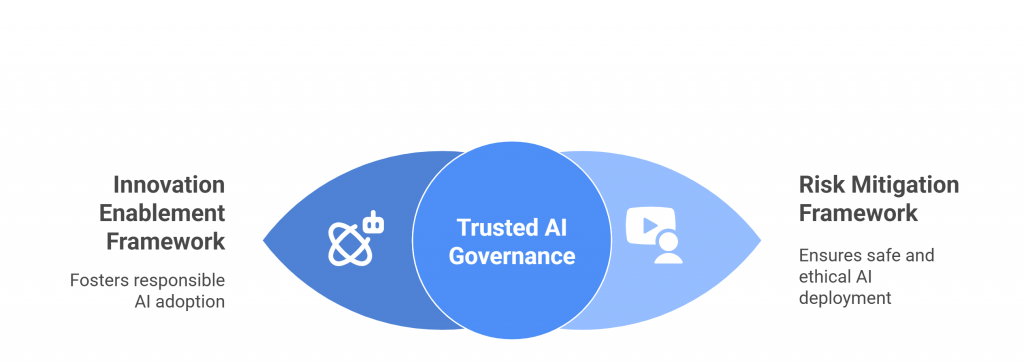
Designed to promote responsible experimentation and adoption, this sub-framework provides the structural foundation for safe AI innovation.
It rests on three pillars:
Focused on governance and safety, this framework ensures that every AI system deployed in finance is auditable, resilient, and ethically aligned.
It too rests on three pillars:
The two frameworks are interdependent—Innovation Enablement provides the tools and confidence to innovate, while Risk Mitigation provides the guardrails to innovate safely.
The FREE-AI Committee outlined 26 recommendations, grouped across these six pillars.
Below is a summary of the key priorities under each.
The FREE-AI Framework envisions a phased, proportionate rollout that allows financial institutions to progressively strengthen their AI governance maturity while preserving operational continuity.
Rather than imposing immediate compliance mandates, the RBI adopts a “learn–adapt–implement” approach—building institutional capacity and regulatory clarity in parallel.
The roadmap is divided into three implementation phases, followed by an ongoing improvement cycle.
Implementation Timeline Overview
| Year | Phase | Focus Area | Key Deliverables |
| 2025–26 | Phase 1 | Awareness & Capacity | AI policies, committees, inventory, training, sandbox setup |
| 2026–27 | Phase 2 | Governance & Integration | Data lifecycle management, audits, fairness testing, coordination body |
| 2027–28 | Phase 3 | Full Implementation | AI audits, repository, reporting, sectoral harmonization |
| Post-2028 | Phase 4 | Continuous Evolution | Certification, periodic reviews, research partnerships, cross-sector sandboxing |
Objective: Build understanding, capacity, and foundational governance structures across the financial ecosystem.
Key Milestones:
Deliverables by end of FY 2026:
Objective: Move from policy formulation to structured governance, testing, and assurance.
Key Milestones:
Deliverables by end of FY 2027:
Objective: Achieve full operational readiness, continuous assurance, and regulatory integration.
Key Milestones:
Deliverables by end of FY 2028:
Objective: Institutionalize responsible AI as an enduring cultural and operational norm.
Key Milestones:
Long-term Outcomes:
The RBI’s FREE-AI roadmap reflects a measured, capacity-first approach—prioritizing education and infrastructure before enforcement.
By 2028, all regulated entities are expected to have mature AI governance systems, institutionalized ethics frameworks, and transparent assurance mechanisms in place.
In the longer term, FREE-AI aims not merely to regulate technology but to cultivate a culture of responsible intelligence—where every AI decision in finance upholds the values of trust, fairness, and human accountability that define India’s financial system.

Organizations invest heavily in security tools, compliance programs, and risk management processes. Yet many security leaders still struggle...
Introduction — When the Cloud Shakes, Compliance Crumbles When AWS’s US-east-1 region went dark, so did thousands of...

As India accelerates toward becoming a digital-first economy, regulatory frameworks are increasingly shaping how enterprises manage data, AI,...